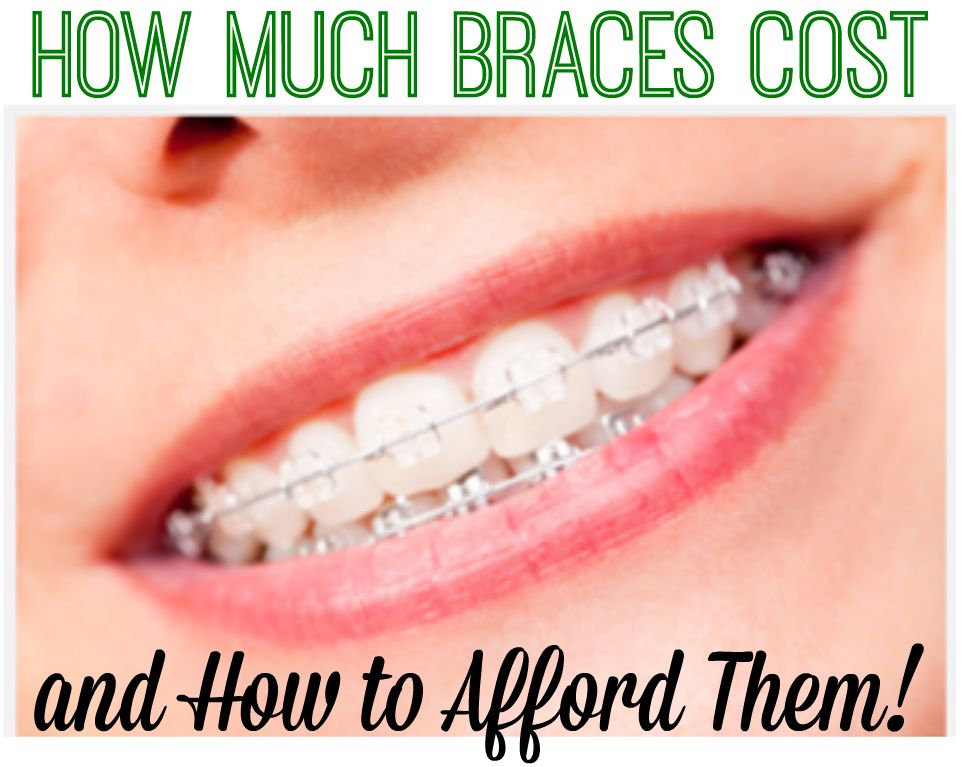
As you know from my recent post, our oldest son recently got braces! That has brought up some questions from readers about “How much they cost…and how do you budget for them?”
So today I'm going to share with you some solid price ranges you can expect for orthodontic treatment as well as a neat trick to be able to work them into your budget and afford them sooner than you think possible.
But first, I have to give you a few disclaimers:
1. Every financial situation is different. If you are in debt (except for your mortgage) or don’t have a $1,000 backup emergency fund then I recommend joining my 10-week $500 challenge in order to get a solid foundation before you add in another large purchase. You will sleep better at night.
2. Prices may vary depending on where you live, what treatment you need done, and who you specifically choose for your Orthodontist. I am giving specific numbers based on my OWN families research here in Brandon FL, from my families OWN Orthodontist (Dr. Turke in Brandon & Tampa, FL – who will give you $250 off for mentioning you heard about him from my blog, by the way!).
How Much Do Braces or Invisalign Usually Cost?
Invisalign is more expensive than braces. They typically cost around $6,000 – $8,000 depending on how much moving needs to be done on your teeth. The Invisalign trays are all made up front, so they require a larger down-payment of about 1/2 to 1/3rd of the total bill.
Braces are typically between $4,000 – $7,000 depending on complexity of treatment. Each of the orthodontists I saw only required around $500 (or less) to get started and then monthly payments around $250. Dr. Turke was $1,500 less than the other orthodontists in my area. And he came highly recommended by several friends, a bonus!
How Can You Afford Braces or Invisalign?
Paid In Full Discount.
Every orthodontist that we visited for a consultation (all consultations were free to take pictures and look at Kevin's teeth and discuss treatment options) had an option to pay the entire total up front for a 5% Discount or they offered a small down payment and monthly payments over the course of his treatment. If you can afford to pay for your whole treatment up front, a 5% Discount will save you $250 on a $5,000 Total. That's like getting one free payment.
Make Some Calculated Sacrifices.
If you don’t have an extra $250 lying around each month but you REALLY want braces/Invisalign for you or your kids, you might have to make some sacrifices. A quick $250? That would be a car payment. You could sell your car or go for a cheaper car (this is a Dave Ramsey trick). You can also look at your other monthly expenses and cut off cable (that is a quick $60-$90 reduction on average) or CUT YOUR GROCERY BILL (hello?!! My family of six spends less than $400 per month to give you an idea of how much savings you could have) or don’t eat out as much (if you spend $60 per week eating out, you can afford braces instead).
Flexible Spending Account or a Health Savings Account
Ask your employer if they provide this type of account, because it is similar to a 0% loan! Here's how they work:
You tell your employer how much money you would like to have withheld out of your paycheck and deposited into a FSA (Flexible Spending Account) and/or HSA (Health Savings Account). Since both of these accounts are pre-tax dollar medical savings accounts, the money you spend on the braces does not count towards your taxable income. That is a huge benefit because it reduces your income on money you STILL GET TO USE! It is just set aside for dental purposes, so the government gives you this perk.
Here's an example:
With an FSA account an employee chooses the amount to be contributed to their account (up to the allowed legal limit) on the first day of any calendar year. That dollar amount is then deducted from your paycheck, pre-tax, every pay day that year. This is nice because you can pay for the orthodontic treatment in full right away, and then you pay back your employer over the remainder of the year. For example: if you decide you want $3,500 contributed into your account on January 1, 2017. That $3,500 will be deducted from your paycheck each month ($291.67) until you have paid your employer back the full $3,500. However, if you only use $2,500 of the money for legal medical expenses by the end of that year you lose the $1,000. Also, with FSA accounts you must submit all of the receipts to the FSA manager or a hold will be placed on your account.

Right now, through November 17th 2016, my son's orthodontist, Dr. Turke will MATCH your down payment made with an FSA Account (up to $250 max). This bonus is eligible for the first 10 patients who reach out to Dr. Turke before 11/17/16.
With an HSA account an employee chooses the amount to be deducted, pre-tax, from their paychecks (up to the legal limit) and accrues a balance. An employee can also write a check to be added to their HSA account and when their taxes are filed at the end of the year that amount will be deducted from their taxable income. Any monies not used by the end of the year, simply roll over. There are no receipts to submit to any account manager. Receipts are simply kept to be filed along with an employees taxes at the end of the year.
Dental Insurance
If you know you’re going to have lots of expensive dental work done, this might be a great option for you because you have time to plan! The coverage plans vary greatly depending on whether you’re employed or not, and the insurance company you go with. However, there is usually a large deductible between $1000 – $3000. And you've gotta be sure to do the math. Add up the deductible, plus the total of the monthly payments in order to ensure that you would actually save money. Also, if you will need jaw surgery or other facial surgery, some of that cost may be covered under your medical health plan instead of your dental plan. Check with your company's benefits coordinator, or call your insurance company directly.
**NOTE: Dentists and Orthodontists are less likely to give discounts and work with you if you have insurance, so REALLY do your math and talk it through with your insurance company and Ortho before deciding to go that route. I will say this too…private plans and self-employed people get hammered because they don’t have the employer volume to pay the plan, so often times you’re better off not getting individual insurance (which is mine and my husband’s case).

Read more about Dr. Turke on his website. Dr. Turke has two offices to serve the Tampa Bay Area, one in Brandon and one in Tampa.
{You'll see neat things such as: he is a member of Idlewild Baptist Church and frequently joins with dentists and physicians on medical and dental missions trips to Mexico and Myanmar (formerly Burma).}
Service Oriented Businesses are legally required to tell you the following information when you are offered a discount (this counts as an “advertisement” because Dr. Turke is allowing you to receive a discount, even though I am simply sharing my personal testimony with my friends):
THE PATIENT AND ANY OTHER PERSON RESPONSIBLE FOR PAYMENT HAS A RIGHT TO REFUSE TO PAY, CANCEL PAYMENT, OR BE REIMBURSED FOR ANY OTHER SERVICE THAT IS PERFORMED AS A RESULT OF AND WITHIN 72 HOURS OF RESPONDING TO THE ADVERTISEMENT